

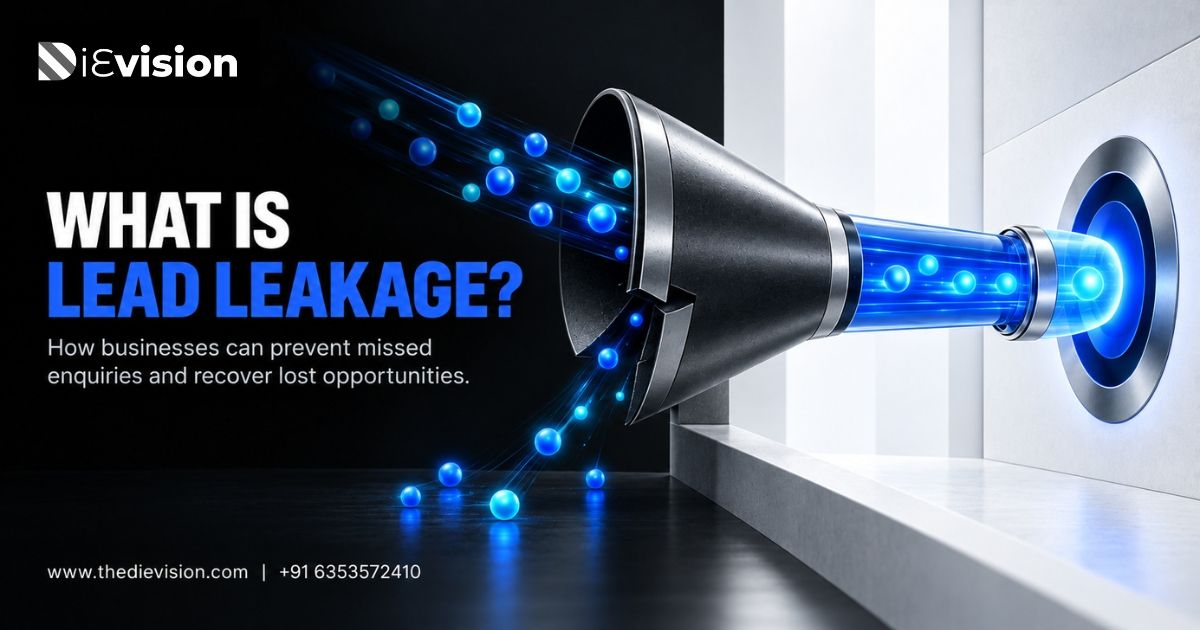
What Is Lead Leakage and How Can Businesses Prevent It?
Lead leakage occurs when enquiries are missed, delayed or poorly followed up. Faster responses and automation can help businesses recover lost opportunities.
What Is Lead Leakage and How Can Businesses Prevent It?
A lead visits your website, fills out a form or sends a WhatsApp message. Your team receives the enquiry, but the response comes hours later. By then, the prospect may have already contacted a competitor.
This is lead leakage.
Lead leakage happens when a business receives potential customer enquiries but fails to respond, qualify or follow up properly. The lead may not be lost because they were not interested. They may be lost because the business did not act at the right time.
What is lead leakage?
Lead leakage is the loss of potential customers during the early stages of the sales process.
It can happen when:
- A website enquiry is not assigned to the right person
- A phone call is missed after business hours
- A WhatsApp message remains unanswered
- A sales representative forgets to follow up
- A lead receives a slow or unclear response
- Customer information is recorded incorrectly
- Marketing and sales teams are not aligned
Even a small gap in the process can affect conversion rates and sales performance.
Why does lead leakage happen?
Slow first responses
People usually contact several businesses while comparing their options. If one company responds quickly with a useful answer, it may get the opportunity first.
A delayed response can make a business appear unavailable or uninterested.
Missed calls and messages
Many enquiries arrive outside working hours. A missed call or unanswered WhatsApp message may never receive a second attempt from the prospect.
Without a proper follow up system, the business may not even know how many opportunities were missed.
Poor lead qualification
Not every enquiry is ready to buy immediately. Some prospects need more information, while others may have a clear budget and timeline.
If every enquiry is treated in the same way, sales teams may spend time on low priority conversations while important leads wait.
Repetitive manual work
Sales and support teams often spend a large part of their day answering the same questions about pricing, availability, services, delivery or appointments.
This leaves less time for meaningful conversations with serious buyers.
No clear handover process
A lead may speak with an AI assistant, marketing executive, sales representative or support team member. If the information is not passed clearly between them, the customer may have to repeat everything.
This creates frustration and increases the chance of losing the enquiry.
How can businesses prevent lead leakage?
1. Respond quickly
The first response should acknowledge the enquiry and provide a useful next step.
This could be:
- An answer to the customer’s question
- A request for important details
- A booking link
- A confirmation that someone from the team will follow up
A fast response keeps the conversation active while the prospect is still interested.
2. Track every enquiry
Businesses should know where every lead comes from and what happens after the first contact.
Important details include:
- Source of the enquiry
- Date and time received
- Assigned team member
- Current status
- Last follow up
- Next action
- Reason for losing the lead
Without this information, it is difficult to identify where opportunities are disappearing.
3. Use automation for routine conversations
AI chatbots, AI voice agents and WhatsApp automation can help manage routine enquiries.
They can:
- Respond to new enquiries
- Answer trained questions
- Collect basic customer information
- Confirm budget, location or timeline
- Schedule appointments
- Send reminders
- Pass qualified leads to the sales team
The purpose is not to replace every human conversation. It is to make sure useful conversations do not wait unnecessarily.
4. Create a clear human handover
Automation should know when to involve a person.
If a conversation involves a complex requirement, complaint, negotiation or unusual request, the system should stop and pass the details to the right team member.
A good handover should include:
- Customer name and contact details
- Requirement
- Budget or purchase intent
- Timeline
- Previous questions
- Recommended next step
This allows the sales team to continue the conversation without asking the customer to repeat the same information.
5. Follow up without overwhelming the prospect
Some leads are interested but not ready to respond immediately. A relevant follow up can bring them back into the conversation.
Follow ups should be:
- Timely
- Helpful
- Related to the original enquiry
- Limited in number
- Easy to answer
Repeated generic messages can create the opposite effect and damage the customer experience.
6. Review the process regularly
Lead leakage is not always caused by one person. It may be caused by a broken process.
Businesses should review:
- Missed calls
- Unanswered messages
- Response time
- Lead assignment
- Follow up completion
- Qualification quality
- Conversion by source
These reviews can reveal whether the main problem is staffing, process, technology or communication.
How AI automation can support lead recovery
A well-designed AI automation system can act as a first response layer for inbound teams.
It can respond to phone calls and WhatsApp enquiries, collect relevant information and send a clear summary to the sales team. It can also identify conversations that require human attention.
The most effective systems are not designed to pretend they can handle everything. They are trained for specific scenarios, follow defined rules and hand complex conversations to people.
This creates a better balance between speed and human support.
Final thoughts
Lead leakage is often invisible. There may be no warning when a prospect stops replying or chooses another company.
That is why businesses need a clear process for responding, qualifying, tracking and following up with every enquiry.
The goal is not to automate every interaction. The goal is to make sure interested customers receive a useful response and a clear next step.
If your business receives enquiries through phone calls, websites or WhatsApp, DieVision Infotech can help identify where leads are being lost and design an automation system around your existing workflow.
Explore our AI Voice and WhatsApp Automation solutions.