

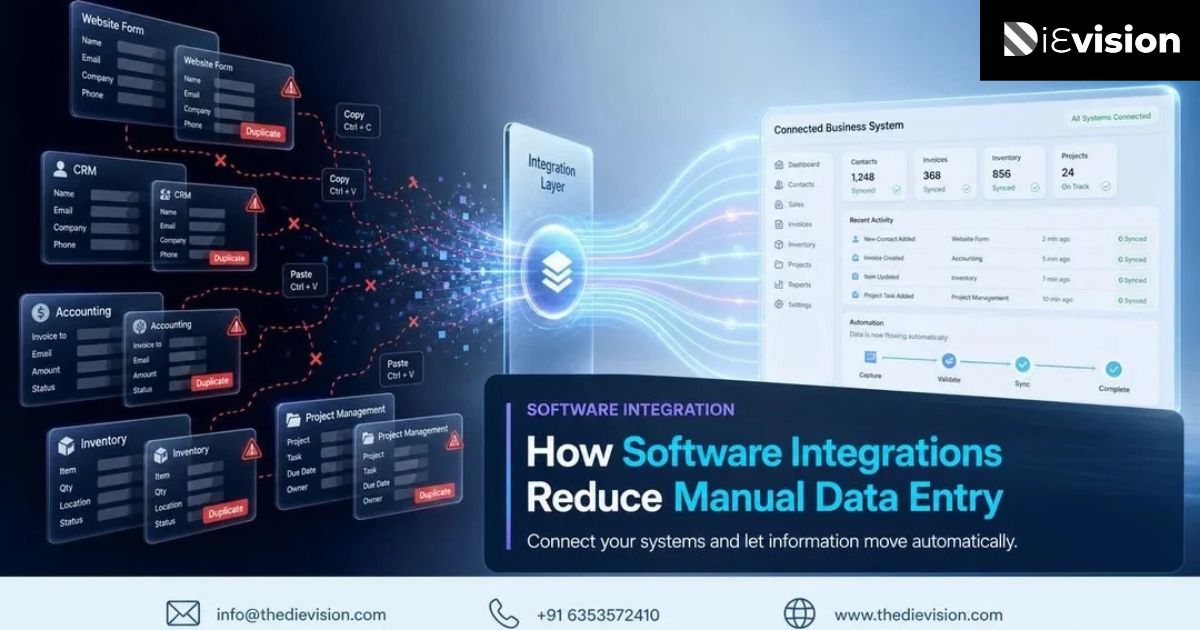
How Software Integrations Reduce Manual Data Entry
Software integrations reduce manual data entry, prevent errors and help business systems share accurate information automatically.
Many businesses use different tools to manage sales, customer service, accounts, projects and daily operations. Each tool may work well on its own, but problems begin when these systems cannot communicate with one another.
Employees then have to copy customer details, order information, invoices and project updates from one platform to another. This may appear manageable at first, but as the business grows, manual data entry becomes slow, expensive and difficult to control.
Software integrations solve this problem by allowing business applications to exchange information automatically.
What Is Software Integration?
Software integration connects two or more applications so that information can move between them without someone entering it repeatedly.
For example, a business may connect its website enquiry form with its customer relationship management system. When a visitor submits the form, their details are automatically added to the CRM and assigned to the appropriate salesperson.
The same information can also trigger a confirmation email, create a follow up task and notify the sales team. One action updates several systems without requiring additional manual work.
Why Manual Data Entry Creates Problems
Manual data entry takes time away from more valuable work. Employees may spend hours transferring information between spreadsheets, CRMs, accounting tools and project management platforms.
It also increases the possibility of mistakes. A wrong email address, missing digit or duplicate record can affect customer communication, reporting and business decisions.
These problems become more serious as the volume of data increases. What works for fifty customers may become impossible to manage when the business has five thousand customers.
Manual processes can also delay important actions. A sales representative may not contact a new lead quickly because the enquiry has not yet been entered into the CRM. An accounts team may send an invoice late because project information has not reached the billing system.
How Software Integrations Reduce Data Entry
The main benefit of software integration is that information only needs to be entered once.
When applications are connected, data can move automatically between the systems that need it. A confirmed online order can update inventory, create an invoice, notify the delivery team and add the customer to the correct communication list.
This removes repetitive work while keeping information consistent across the business.
Integrations can also validate information before it enters another system. Required fields, formats and duplicate records can be checked automatically. This improves data quality and reduces the time employees spend correcting errors.
Common Software Integration Examples
Businesses can use integrations in many everyday processes.
A website can send enquiries directly to a CRM. An ecommerce platform can share order information with accounting and inventory systems. A project management tool can send completed work details to invoicing software. A support platform can display customer history from the CRM.
Marketing platforms can also receive updated customer information automatically. This allows businesses to send relevant messages without maintaining separate contact lists.
The right integration depends on how the business works and where employees currently repeat the same tasks.
Benefits Beyond Saving Time
Reducing manual data entry improves more than productivity. It can also create a faster and more consistent customer experience.
Sales teams receive enquiries sooner. Support teams have access to accurate customer information. Managers can view reports based on current data instead of waiting for spreadsheets to be updated.
Employees also spend less time completing routine administrative work. They can focus on customer conversations, problem solving and activities that contribute directly to growth.
When Does a Business Need Custom Integration?
Some commonly used applications already provide standard integrations. However, these connections may not support every workflow or business requirement.
A custom software integration may be necessary when a company uses specialised systems, has complex approval processes or needs information to move according to specific rules.
Before building an integration, the existing process should be reviewed carefully. The goal is not to automate every step. It is to remove unnecessary work and create a reliable flow of information.
Build a More Connected Business
Manual data entry is often treated as a normal part of running a business. In reality, it can signal that important systems are disconnected.
Software integrations connect these systems, reduce errors and help teams work with accurate information. The result is a business that can respond faster and grow without adding more repetitive work.
DieVision Infotech develops custom software integrations and automation solutions built around real business processes. If your team spends too much time moving information between systems, visit www.thedievision.com to discuss a more connected approach.